
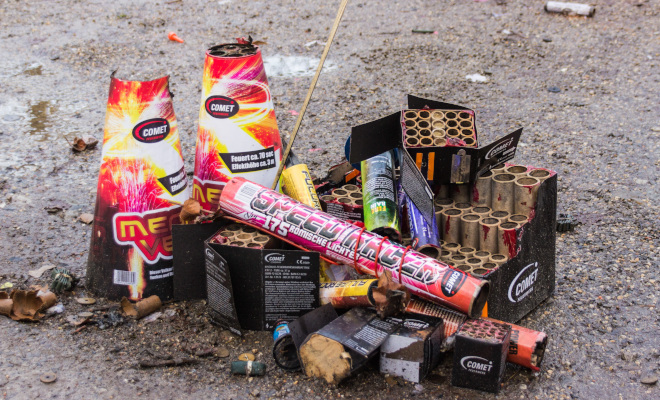
The use of illegal fireworks has gotten out of hand this year. Seven weeks to Halloween and fireworks are already a nightly occurrence. Neasa Hourigan has written to the Minister for Justice to ask her to do more on combating this issue and has included some proposals the Minister can act on. Let us know if you have additional suggestions on how to tackle this problem at Neasa.Hourigan@oir.ie.
The issues around the use of illegal fireworks are numerous: potential for injury to the persons setting off the fireworks or persons who may be struck by the fireworks; potential for damage to property or person due to fire; issues for pets many of whom do not cope well with loud noises; general noise disruptions over a long period which can be problematic for vulnerable people. Over the past few years there have been sad cases of children suffering serious, life changing injuries as a result of firework misuse.
On the 18th August Neasa Hourigan put a question in to the Minister for Justice, Helen McEntee on her plans to prevent and detect the importation and sale of illegal fireworks in the State. Even at that early stage reports were coming in from communities in Dublin Central and around the country that illegal fireworks were in widespread use.
The Minister’s response is included below. While the Minister’s plan includes a number of good points it is clear that this year more needs to be done. Neasa has written to the Minister to ask her to consider:
Immediate term solutions:
- Increase funding to Operation Tombola
- Have the An Garda Síochána review pages on social media selling fireworks
- To act as a deterrent, consider publicising some convictions for the importation and/or sale of fireworks
Longer term solutions:
- In future years commence Operation Tombola (or equivalent) earlier.
- Diversionary approaches - COVID-19 means that any large scale gathering is not possible this year. In future years however, if possible, the Department should work with local authorities on local fireworks displays as a diversionary tactic.
- North-South cooperation on preventing the sale of fireworks to Irish residents
- Liaise with other police forces to learn best practices on the prevention of firework abuse e.g. UK approach
- Review whether application of a nominal excise tax would facilitate fireworks being controlled under the Excise Movement Control System and targeted via extra physical checks on containers.
—-
Response from Minister for Justice
The Deputy may be aware that fireworks are classified into four separate categories, depending on their level of hazard and whether they require specialist knowledge for use. Category F1 is the least hazardous category and covers party poppers and sparklers, while Category F4 represents the most hazardous.
In the interests of safety and security, it is Government policy to restrict the availability of the more hazardous fireworks to the general public - including categories F2, F3 and F4. A licence is required to import fireworks in any of these categories. Licences under the Explosives Act are issued by my Department only for the importation of fireworks which are to be used in organised displays conducted by professional and competent operators.
Every year, as we approach Halloween, my Department runs an awareness campaign aimed at ensuring the public knows about the legislation governing the importation and use of fireworks. We highlight the fact that the importation and use of fireworks without a licence is illegal and inform the public of the severe penalties that can attach to firework related offences.
An example of the penalties faced include a fine of up to €10,000 and up to five years imprisonment if convicted of having fireworks in your possession with intent to sell or supply. Igniting fireworks or throwing an ignited firework at a person or property is also liable to the same severe penalty. These penalties illustrate how seriously such offences are taken.
As well as this awareness raising work undertaken by my Department in the run up to Halloween, additional efforts are made by An Garda Síochána at this time of year to combat the illegal importation, sale and use of fireworks, known as Operation Tombola. The Garda Commissioner informs me that under Operation Tombola each District prepares an Operational Plan to tackle the sale of fireworks including through:
- Combating the importation, sale and distribution of illegal fireworks, through intelligence led operations, visits to local car boot sales, searches and seizures of fireworks.
- Liaising with local authorities and Fire Services regarding the provision of official, supervised bonfire sites, the policing of these, and the identification and removal of stockpiled bonfire material and abandoned vehicles from other locations.
- Promoting awareness of the danger associated with the improper use of fireworks and unsupervised bonfires through the use of the media, social media, school visits and information leaflet distribution by members and the Crime Prevention Officer.
- High visibility policing of the Halloween night celebrations, i.e. beat, bike and mobile patrols, thus preventing damage to property, injury, trauma for the vulnerable and the elderly, and general loutish behaviour.
- Utilising the Divisional Public Order Unit on Halloween Night.
Operation Tombola also focuses on preventing associated public disorder and anti-social behaviour through the incremental deployment of resources, including Garda Public Order Units to augment local plans as appropriate.
It may also interest the Deputy to know that on the evening of 4 September 2020, as part of ongoing operations, Gardaí from the Mallow District Drugs Unit, assisted by Gardaí from Mallow and the Southern Region Dog Unit executed two search warrants at houses in Mallow town. During the course of the first search Gardaí seized a number of items, including 490 fireworks.
—-
Image credit